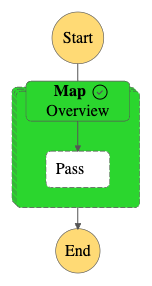
I’m using AWS Step Functions to do some complex orchestration of services that could span more than 25,000 state transitions and exchange data sets larger than 256KB, so I’m making heavy use of the new distributed map feature. It definitely makes things easier than the old everything-is-a-child-execution approach! However, the ResultWriter field is not particularly well-documented, so I’m hoping to shed some light on it here with a simple example.
I’ve added a new custom base image for Java 20 on Lambda to complement the community base images already available for Java 17, Java 18, and Java 19. You can find the images on the ECR Public Gallery and DockerHub and the source code on GitHub. All the new features in Java 20 are in preview or incubator, as befits a non-LTS release, but for those who like to live life on the bleeding edge, there’s lots of new toys to play with. These base images will let you get started.
In my opinion, JDBI is simply the best database access framework for relational databases available for Java today. My new library, JDBQ, is essentially a port of JDBI from relational databases to Google BigQuery.
I’m (finally) upgrading several projects to Java 17, the current LTS version. I like to deploy my Lambda functions as container images because it keeps the devops simple — everything is a container! — but there still isn’t an officially-supported base image Java 17, even though it’s been out for almost a year. So I made one and released it to the community. You can find the images on ECR Public Gallery and DockerHub, and the source code is on GitHub. If you’ve been waiting to adopt Java 17 until there was Lambda support, then these base images will let you get started.
I just released the first beta version of litecene, a Java library that implements a common boolean search syntax for full-text search, with its first transpiler for BigQuery.
Litecene makes Searching Text in BigQuery Easy!
Litecene Syntax
Litecene uses a simple, user-friendly syntax that is derived from Lucene query syntax that should be familiar to most users. It includes clauses for term with wildcard, phrase with proximity, AND, OR, NOT, and grouping.
As an example, this might be a good Litecene query to identify social media posts talking about common ways people user their smartphones:
(smartphone OR "smart phone" OR iphone OR "apple phone" OR android OR "google phone" OR "windows phone" OR "phone app"~8) AND (call* OR dial* OR app OR surf* OR brows* OR camera* OR pic* OR selfie)
I was investigating the feasibility of putting natively-formatted Twitter data into BigQuery, and got pretty far along the way before deciding to go another direction. I found the schema in the twitter-for-bigquery project to be incomplete for my needs, so I made a new schema of my own. I’m making the schema available here in case it’s of use to anyone else.